
Six Waves of Welsh Emigration, 1700–1950
Who left Wales for North America, why they went and where they settled.
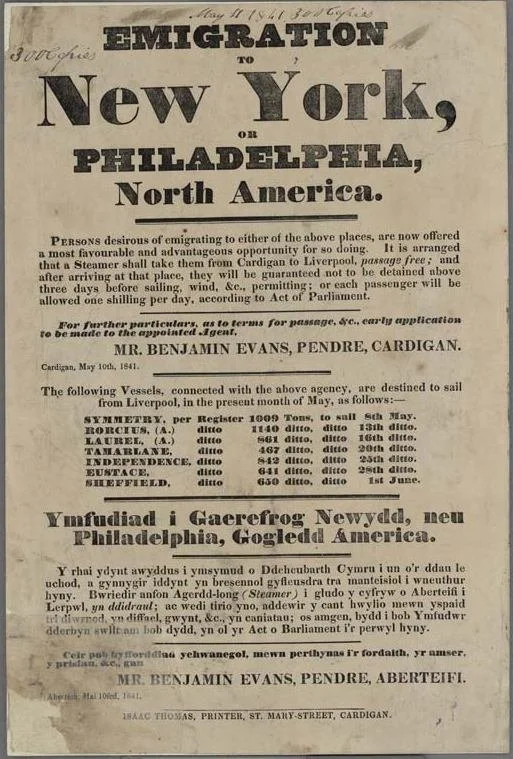
Emigration poster, 1841. National Library of Wales, public domain, via Wikimedia Commons.
Introduction
Fewer people emigrated from Wales than from England, Scotland or Ireland [1, 2]: in proportion to population, Irish emigration to the USA was about 25 times greater than Welsh [2]. Most Welsh people who left home went no further than the south Wales coalfield or England [3, 2]. The six waves below trace those who crossed the Atlantic, and we’ll end with the people behind the numbers.¹
Wave 1 · Religious dissenters, c.1660–1720
Nonconformists left in search of religious freedom: John Myles’s Baptists, who left in 1663 and founded Swansea, Massachusetts, and from 1682 Welsh Quakers to William Penn’s Welsh Tract in Pennsylvania [2, 4], leaving place names such as Radnor, Haverford and Narberth [2].
Non-Wave 2 · Eighteenth-century lull, c.1720–1790
Emigration then fell to a trickle for about seventy years, a period historian Bill Jones calls one of “stagnation” [4].
Wave 3 · Agrarian revival and early Canada, c.1790–1845
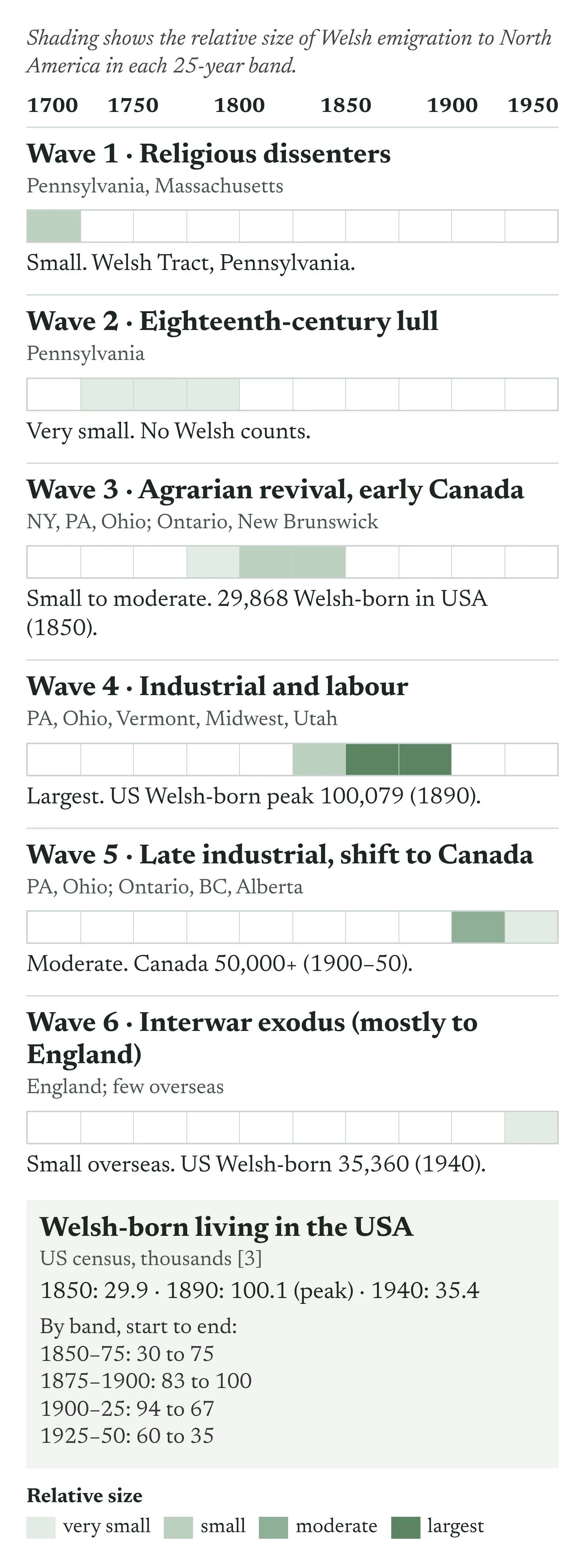
Rural “folk” migration of farming families and chapel groups revived in the 1790s [4], driven by population growth, high rents and taxes, the failed harvests of 1815–16 and the farming depression after the Napoleonic Wars [5, 2]. Settlers founded Cambria, Pennsylvania (1798) [2], then moved into Ohio: by 1850 about 3,000 Cardiganshire people had crossed, many to Jackson and Gallia counties [5]. In Canada, Southwold, Ontario (1817; 385 Welsh by 1850) and Cardigan Settlement, New Brunswick (1819; about 150 settlers) were among the first Welsh settlements [6]. By 1850 the USA had 29,868 Welsh-born residents [3].
Wave 4 · Industrial and labour migration, c.1845–1900 (main wave)
Emigrants were now mostly skilled workers [4, 2]: miners and ironworkers to Pennsylvania (notably Scranton) and Ohio; nearly 1,500 slate quarrymen to Vermont in 1845–51; tinplate workers after the McKinley Tariff of the early 1890s [1, 4]. Farmers moved west to Wisconsin and the Plains until the 1890s [4], and Latter-day Saints to Utah (945 Welsh-born there by 1860) [3]. The US Welsh-born population rose from 45,763 (1860) to a peak of 100,079 (1890) [3], about 5.6% of Wales’s population. Canada drew smaller groups, such as the 1862 Cariboo gold-rush party [1, 7].
Wave 5 · Late industrial wave and the shift to Canada, c.1900–1930
The coal boom now pulled people into Wales (a net gain of 98,492 in 1901–11), and the US Welsh-born population fell from 93,586 (1900) to 60,203 (1930) [3]. Canada rose in importance: 5,018 Welsh arrivals in 1906 alone, and more than 50,000 in the first half of the twentieth century, mainly to the mining districts of Ontario, British Columbia and Alberta and to western farms [7, 2]. Just over 200 Welsh settlers moved from Patagonia to Canada in 1902 [2]. US quotas capped British entry (34,007 a year in 1926) [8], while the Empire Settlement Act 1922 assisted about 165,000 Britons to Canada, though about 75% of the miners recruited for the 1928 harvest scheme went home [9].
Wave 6 · Interwar exodus and wind-down, c.1930–1950
The collapse of coal drove more than 400,000 people out of Wales between the wars, 85% of them from Glamorgan and Monmouthshire [10, 2]. Most went to English towns such as Oxford, Slough and Birmingham [2]. Overseas emigration was small: assisted schemes ended around 1930 [9] and the US Welsh-born population fell to 35,360 by 1940 [3]. Patagonia and Australia drew far fewer Welsh emigrants than North America [2].
Behind the waves: the people who left
The waves show the broad pattern, but as Jones reminds us, emigration was ultimately “the result of individual choice in which personal reasons played a large part” [4, p. 9]. Economic hopes mattered to most: cheap land and lower rents for farmers, and higher wages for skilled colliers, quarrymen and tinplaters [4, pp. 7–8]. Yet the decision was usually made within a family or a community. In 1818 the innkeeper John Jones of Tirbach led six extended families from Cilcennin to Ohio [5]. John Mathews, returning from America to find his family living in poverty, resettled them in Ontario [6]. Young men emigrated most, often at turning points such as marriage or a parent’s death [4, p. 9]. News travelled through letters passed “from hand to hand and house to house” [4, p. 10], and men often went first, with wives and children following months or years later [1]. Some agonised for years; others left almost overnight. Dafydd Shon of Tir-y-twrchbren had felt “an urge to come to America” for years, but a tax collector’s insult settled it, and his wife simply replied, “I’ll go as well” [4, p. 23]. Nor was leaving always final: an estimated 40% of Welsh emigrants in 1870–1914 eventually returned home, far more than from other parts of Britain, helped by faster and cheaper steamship crossings [2; 1; 4, p. 16]. Yet most stayed: in 1890 according to US Census data more than 100,000 people born in Wales were living in the USA [3]. For family historians, this is the reminder that behind every statistic was a household weighing hope, risk and the pull of home.
Post Researched & Created by
Nathan Wymark Payne
“It was rather hard to leave the old house and the old neighbourhood, and old friends, and cross the sea to this country.”
Footnotes:
Welsh numbers are minimums. British records counted Welsh emigrants as English until 1908–13, and US and Canadian records often did the same [11, 4, 12, 7]. The US census of Welsh-born residents (from 1850) is the most consistent series, which is why researchers rely on it [3].
The shading in the graph is my estimate of relative size, based on the figures above; no single Welsh series covers 1700–1950.
Sources:
“Working Abroad: Welsh Emigration.” People’s Collection Wales, https://www.peoplescollection.wales/content/working-abroad-welsh-emigration, accessed 20th November 2026.
“Patterns of Migration: The Welsh Context.” GwE, 2018, PDF, https://www.gwegogledd.cymru/wp-content/uploads/2019/02/patterns-of-migration-welsh-context.pdf, accessed 20th November 2026.
Welsh Government. Digest of Welsh Historical Statistics 1700–1974, Chapter 1: Population, Tables 1.1, 1.14 and 1.15. Excel workbook, UK Government Web Archive (capture of 2 April 2015), https://webarchive.nationalarchives.gov.uk/ukgwa/20150402173126/http:/gov.wales/statistics-and-research/digest-welsh-historical-statistics/, accessed 20th November 2026.
Jones, Bill. “Raising the Wind”: Emigrating from Wales to the USA in the Late Nineteenth and Early Twentieth Centuries. Cardiff Centre for Welsh American Studies, Cardiff University, 2004 (First Annual Public Lecture, delivered 20 May 2003), https://orca.cardiff.ac.uk/48163/1/RaisingTheWind.pdf, accessed 20th November 2026.
“Aberaeron, Ceredigion to Ohio, 1818.” Ceredigion History, https://ceredigionhistory.wales/1818-aberaeron-ceredigion-to-ohio/, accessed 20th November 2026.
Chapman, Andrew. “Tir Newydd: New Land.” The Genealogist, February 2014, https://www.thegenealogist.co.uk/featuredarticles/discover-your-ancestors/bookazine/3/tir-newydd-new-land-7295/, accessed 20th November 2026.
Evans, David, Kalbach, Madeline A. and Graves, Bronwyn. “Welsh Canadians.” The Canadian Encyclopedia, Historica Canada, 29 May 2008 (last edited 28 April 2021), https://thecanadianencyclopedia.ca/en/article/welsh, accessed 20th November 2026.
“Immigration Quotas (United Kingdom and Germany).” Hansard, HC Deb 9 November 1926, vol. 199, cc. 875–6, https://api.parliament.uk/historic-hansard/commons/1926/nov/09/immigration-quotas-united-kingdom-and, accessed 20th November 2026.
“Empire Settlement Act, 1922.” Canadian Museum of Immigration at Pier 21, https://pier21.ca/research/immigration-history/empire-settlement-act-1922, accessed 20th November 2026.
WJEC. “Life in Wales during the Depression.” Teaching resource (PDF), https://resource.download.wjec.co.uk/vtc/2023-24/mfw/mfw23-24_8-34/pdf/en/1-6-2_life-in-wales-during-the-depression.pdf, accessed 20th November 2026.
“Welsh Emigrants.” Hansard, HC Deb 25 April 1895, vol. 32, c. 1628, https://api.parliament.uk/historic-hansard/commons/1895/apr/25/welsh-emigrants, accessed 20th November 2026.
Willcox, Walter F. “Statistics of Migrations, National Tables, United States.” In International Migrations, Vol. I: Statistics, National Bureau of Economic Research, 1929, pp. 372–498, https://www.nber.org/chapters/c5134.pdf, accessed 20th November 2026.
Genealogist for hire:
Welsh family history.
A chapel register.
A passenger list.
A family, traced across the Atlantic.
Genealogy services: British roots, North American families.
A record search.
A family story.
A journey to the village.