
Six Waves of Scottish Emigration,
1700–1940
Who left Scotland for North America, why they went and where they settled.
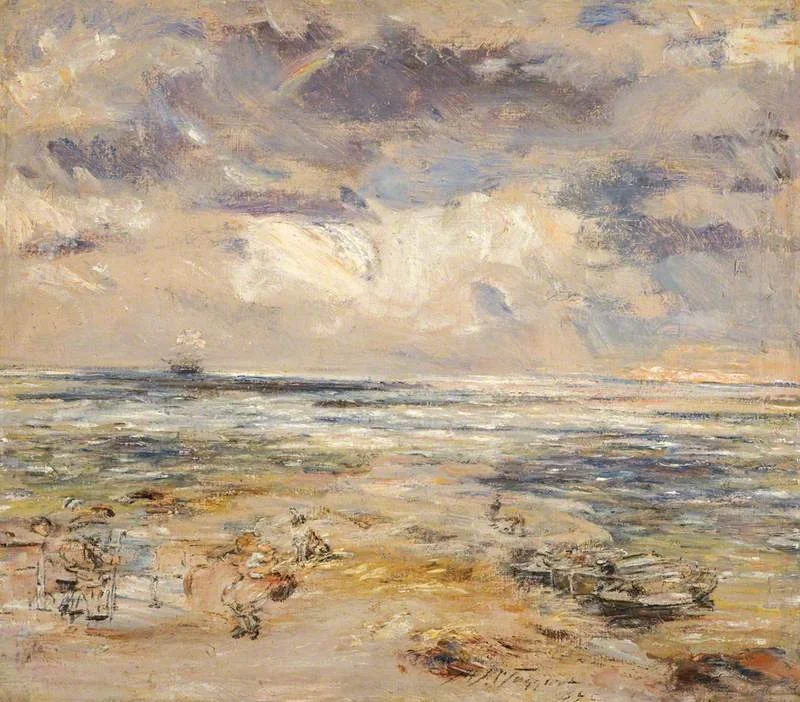
The Sailing of the Emigrant Ship, William McTaggart
National Galleries of Scotland Collection
Introduction
The image that headlines this post is a painting by William McTaggart, a Scottish artist. I chose this because I stood in front of it at the National Galleries of Scotland, and I have not forgotten it. We see the emigrant ship under a stormy sky, almost at the horizon, with older people and a dog still on the shore, left behind. A painting of Scots leaving hangs in their national gallery today, which reminds visitors how much of the country left, and the impact Scottish immigration had on the world.
In the nineteenth century only Ireland and Norway regularly sent more of their people abroad than Scotland did [1, p. 116]. Most of those who left in that period crossed the Atlantic to the United States and Canada. Others settled in Australia, New Zealand, the Caribbean, India, and England between 1841 and 1911 [2, p. 3; 3; 1, p. 114].
The popular picture is the Highlander driven out by the Clearances. That story is real, and it is one chapter of many. From the mid-nineteenth century most emigrants came from the towns and farms of the Lowlands [4]. The waves below follow those who crossed the Atlantic, and I end with the people behind the macro picture and the numbers.¹
~2,000,000
Scots who left in the nineteenth century [2, p. 3]
1 in 10
Scots who emigrated overseas 1901–1910 [5]
Before 1700 · Europe first, then Ulster
For centuries most Scots who left stayed in Europe, going to England, Scandinavia, Poland and the Low Countries as soldiers, pedlars and merchants [3]. In the seventeenth century the flow turned west, to Ulster in the north of Ireland: up to 30,000 Lowlanders had gone by 1641, and perhaps 60,000–100,000 more followed by 1700 [2, p. 16].² Few yet looked across the Atlantic. Those who did were mostly prisoners and religious exiles bound for Virginia [2, pp. 16–18].
Wave 1 · Colonial trade and settlement, c.1700–1760
The Union of 1707 opened England's colonies and trade to Scots, and they went west [2, p. 18; 3]. Most were Lowlanders: tradesmen, farmers, doctors, fur traders hired by the Hudson's Bay Company, Caribbean planters and the tobacco merchants of the Chesapeake. By the 1770s most of Virginia's 2,000 factors, the resident agents, were Scots working for Glasgow firms [2, pp. 18–19]. Many crossed as indentured servants, working up to seven years for their passage [2, p. 20]. Not all went willingly: about 600 Jacobite prisoners were exiled after each of the risings of 1715 and 1745–46, mainly to North Carolina [2, p. 20]. The Hudson's Bay Company, founded in 1670, hired most of its eighteenth-century labourers and tradesmen in Orkney [6].
Wave 2 · “Emigration fever”, c.1760–1800
From the 1760s whole families began to leave together, and the Highlands led [2, p. 20]. Rents rose, old townships broke up and farms began becoming sheep walks. Cheap freehold land in America did the rest [2, p. 21; 4]. Most Highland emigrants were middle-ranking tenants who paid their own way, often against their landlords' wishes. Lowland farmers formed emigration companies: the Inchinnan Company of Renfrewshire bought land at Ryegate, Vermont, in 1773 [2, p. 20]. That same year the Hector carried almost 200 Highlanders from Loch Broom to Pictou, Nova Scotia, and large-scale Scottish settlement of Canada's Maritime provinces began [2, p. 199].
Wave 3 · Clearances, famine and assisted passages, c.1815–1855
The end of the Napoleonic Wars in 1815 brought hardship to Lowlands and Highlands alike. Soldiers came home to an overstocked labour market, farming and industry slumped, and the population growing [2, p. 37]. This is the era most people picture, the Highland Clearances are key to the definition of this period. They were one driver among several, as Lowland weavers were among the first to be helped across the Atlantic.
The government offered free passage and 100-acre grants in the Ottawa Valley in 1815, and about 700 Scots took them [2, p. 37]. In 1819–20 west-of-Scotland weavers, put out of work by depression and the power loom, formed 35 emigration societies and petitioned their way to government help [2, pp. 38–39; 4]. In the Highlands the kelp, cattle and distilling trades collapsed, tenants came to depend on the potato, and landlords turned land over to sheep and saw emigration as the cure for overpopulation [2, p. 45]. When the potato failed in 1846, Outer Hebridean landlords stepped up subsidised emigration, and some evictions, such as those on John Gordon's estates in Barra and South Uist, became notorious [4].
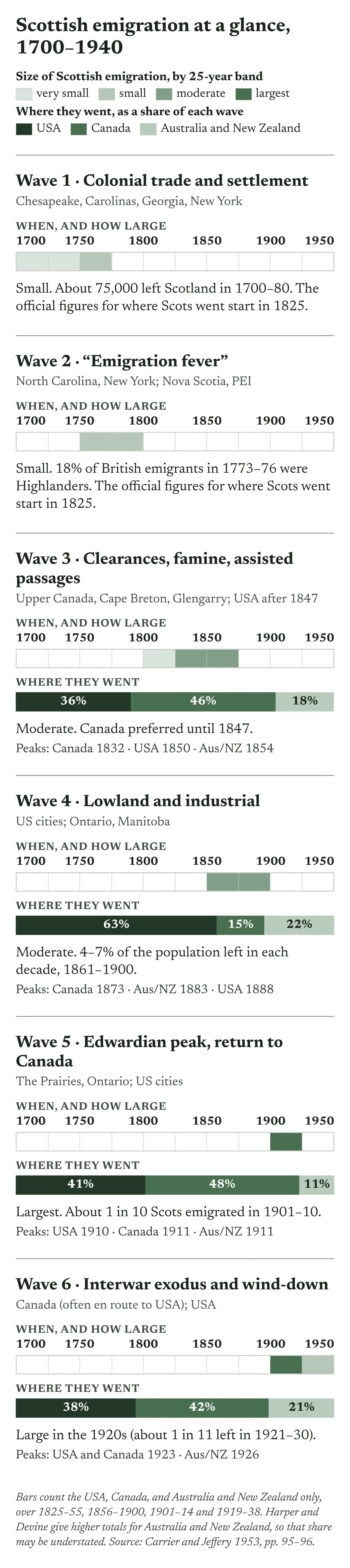
Until 1847 Scots preferred Canada (then the British Province of Canada) to the United States [2, p. 3]. It was relatively close and cheap: timber ships returning to Quebec and Montreal carried emigrants as paying ballast, at about £3–£4 in steerage [2, pp. 201–202; 4]. Earlier settlers drew friends and relatives after them. As the data graph on this page shows, after 1847 the industralising United States became the main destination [2, p. 3].
Wave 4 · Lowland and industrial emigration, c.1855–1900
In the second half of the century the exodus changed character. After 1860 Highlanders were far outnumbered by emigrants from the Lowlands [4]. People born in the urban Central Lowlands made up more than half of all Scottish emigrants in every decade after 1871, a count that includes those who moved to England [7, pp. 215–216]. The United States drew mostly town-dwellers, while Canada, Australia and New Zealand took tenant farmers and farm servants [3]. In ten of the twelve years from 1853 to 1864, more Scots sailed to Australia and New Zealand than to the United States or Canada [8, pp. 95–96].
Steamships changed the crossing. By 1879, when Robert Louis Stevenson sailed from Greenock to New York, a voyage that once took one to three months took under a fortnight [2, p. 197]. That made seasonal work abroad possible: several hundred Aberdeen granite workers crossed to American yards each spring and came home for the winter [1, p. 126]. After 1867, as the fur trade declined, north-east Scotland became the Hudson's Bay Company's main source of clerks and store managers, recruited through newspaper advertisements and local schools [6].
Wave 5 · The Edwardian peak and the return to Canada, c.1900–1914
Scottish emigration reached its highest rate in the decade before the First World War. Across 1901–10 about one Scot in ten emigrated, and in 1913 Scotland's outflow was larger than Ireland's or Norway's [5; 1, p. 116]. Canada became Scots' first choice again in 1907 [4], and the number of Scottish-born people living there doubled in a decade, from 83,631 in 1901 to 169,391 in 1911 [10].
This time Canada went out to find its settlers. Government agents were based in Glasgow from 1869 and Aberdeen from 1907, with thousands of local booking agents reaching the remotest corners of Scotland [4]. Agents took magic-lantern lectures, illustrated talks given with an early slide projector, round markets, fairs and village halls; W. G. Stuart, the agent for the north, could lecture in Gaelic [1, p. 127]. Under Clifford Sifton, Canada's Minister of the Interior from 1896 to 1905, agents were paid a commission for every settler who stayed [1, pp. 127–128]. The Canadian Pacific Railway, granted 25 million acres of prairie in 1880, even sold ready-made farms in southern Alberta, with housing, barns and fences included [1, p. 125].
Wave 6 · Interwar exodus and wind-down, c.1919–1940
When the brief post-war boom ended in 1921, unemployment in shipbuilding and heavy industry drove a new exodus [5; 11]. In the 1920s no European country lost a larger share of its people to emigration than Scotland [1, p. 187]. In April 1923 about 600 people left the Outer Hebrides in a single week on two Canadian Pacific liners, the Metagama and the Marloch, many on subsidised passages [11; 4]. Many artisans took assisted passages to Canada and then crossed into the United States, often illegally [4]. In the peak year of 1924, 80% of Scottish emigrants to the United States were skilled men from the depressed shipbuilding and engineering industries of Clydeside [1, p. 187]. The Depression ended the boom. By 1930 emigration had fallen to about half of one per cent of the population a year [5], and many emigrants came home as unemployment rocketed in the United States [1, p. 187].
The people behind the data
The waves show the pattern, but every departure was a decision made by a person or a family. Push and pull were rarely separate: most emigrants weighed hardship at home against life overseas, and the balance shifted with time, place, occupation and temperament [2, p. 32]. Sometimes chance decided. In 1887 the Glasgow family of twelve-year-old Wellwood Rattray let the toss of a coin choose their destination. They went to Saskatchewan [4].
News travelled by letter. Pioneer settlers persuaded most, especially when they enclosed money with their advice, and some came home to lead family, friends and neighbours out [4]. On Skye in 1773, James Boswell watched islanders dance a reel called “America”, which he took as emigration spreading “till all are set afloat” [5].
Leaving was an ordeal. On the Hector's ten-week voyage in 1773, smallpox and dysentery broke out and eighteen children died [2, p. 199]. At Liverpool, the busiest port of departure, families who missed the gangplank had to scramble aboard with their luggage as the ship moved off, some climbing the rigging amid what one reporter called "a screaming, a swearing and a shouting" [2, pp. 203–204]. Arrival brought its own trials. Peter Hastie, an Edinburgh shopkeeper turned canal engineer, lived through New York's cholera epidemic of 1832 before he found work [12]. A century later, ten-year-old Morag Bennett left Benbecula for Alberta in 1923. She remembered the icebergs and the wonder of running water on board, while her parents were daunted by the prairie climate [11]. Agnes MacGilvray left Whithorn in Galloway for New York in 1930, lured by better wages, and spent her evenings at Broadway shows [11].
Leaving was not always final. By the end of the nineteenth century perhaps a third of Scottish emigrants eventually came home [3; 4]. Yet most stayed: in 1930–31 more than 630,000 people born in Scotland were living in the United States and Canada [9; 10]. For family historians, this is the reminder that behind every statistic was a household weighing hope, risk and the pull of home.
Post Researched & Created by
Nathan Wymark Payne
“I find however that I can get along very well with the Americans & I don’t dislike the Country.”
Genealogist for hire:
Scottish family history.
A record search.
A passenger list.
A family, traced across the Atlantic.
Genealogy services:
British roots, North American families.
A record search.
A family story.
A journey to the village.
Footnotes
Scottish figures are approximate. Until 1853 British returns recorded emigrants by port of departure, Scots who sailed from Liverpool were counted as English, and Irish who sailed from Glasgow as Scots. Counts before 1853 therefore understate Scottish emigration to the US and Australasia more than to Canada, and probably exaggerate Canada's early lead [2, pp. 2–3; 8, p. 29]. The US and Canadian censuses count birthplace, not ancestry [9; 10].
These figures count people who left Scotland itself. Descendants of Scots who moved to Ulster, often called the Scots-Irish, sailed from Irish ports and belong to the story of Irish emigration.
The shading in the chart is my estimate of relative size, as I found no single Scottish series covering 1700–1940.
Sources
Devine, T. M. To the Ends of the Earth: Scotland's Global Diaspora, 1750–2010. Penguin, London, 2011. Google Play Books, accessed 21st November 2026.
Harper, Marjory. Adventurers and Exiles: The Great Scottish Exodus. Profile Books, London, 2004 (first published 2003). Internet Archive, https://archive.org/details/adventurersexile0000harp, accessed 21st November 2026.
“Emigration.” Your Scottish Archives, contributors Rosemary Gibson et al. (2002), edited by David Brown and Elspeth Reid (2021), https://yourscottisharchives.com/emigration, accessed 21st November 2026.
Harper, Marjory. “Crossing borders: Scottish emigration to Canada.” History in Focus, Issue 11 (Migration), Institute of Historical Research, Autumn 2006, https://archives.history.ac.uk/history-in-focus/Migration/articles/harper.html, accessed 21st November 2026.
“The Long Emigration.” ScottishInventions.com, https://scottishinventions.com/shadow/the-long-emigration, accessed 21st November 2026. Used for the annual emigration rates of Baines (1985), as tabulated by McCarthy (2012), Table 27.3 and reproduced on this page. The rates imply about 46,900 emigrants a year in the 1920s, matching the 46,876 given by Devine [1, p. 116].
Department of Anthropology, University of Aberdeen. “Joining Up.” Material Histories: Scots and Aboriginal Peoples in the Canadian Fur Trade (AHRC-funded project), University of Aberdeen, https://www.abdn.ac.uk/materialhistories/joining.php, undated, accessed 21st November 2026.
Brock, Jeanette M. The Mobile Scot: A Study of Emigration and Migration, 1861–1911. John Donald, Edinburgh, 1999. Internet Archive, https://archive.org/details/mobilescotstudyo0000broc, accessed 21st November 2026.
Carrier, N. H. and Jeffery, James R. External Migration: A Study of the Available Statistics, 1815–1950. General Register Office, H.M. Stationery Office, London, 1953, Table 4 (p. 29), Table D/F/G(1) (pp. 95–96) and Appendix 2 (p. 149). Google Play Books, https://books.google.com/books?id=CCkTAAAAIAAJ, accessed 21st November 2026.
Gibson, Campbell and Jung, Kay. Historical Census Statistics on the Foreign-Born Population of the United States: 1850 to 2000. Working Paper No. 81, Population Division, U.S. Census Bureau, February 2006, Table 4, https://www.census.gov/library/working-papers/2006/demo/POP-twps0081.html, accessed 21st November 2026.
Statistics Canada. Table 43-10-0008-01 (formerly CANSIM 075-0022), “Historical statistics, country of birth of other British-born and foreign-born population”, 1871–1971, https://doi.org/10.25318/4310000801-eng, accessed 21st November 2026. The table publishes no footnotes on coverage.
University of Aberdeen. “Stories of Scots emigrants told in their own words.” University of Aberdeen News, 30 November 2020, https://www.abdn.ac.uk/news/14521/, accessed 21st November 2026.
Hastie, Peter. Letter to Mrs James Scott, Selkirk, 16 March 1834. Transcription, “Peter Hastie's story”, National Library of Scotland, Acc.12249/2, https://digital.nls.uk/emigration/settling/peter-hastie/index.html, accessed 21st November 2026.