Emigrant Farewells
When emigrant families left their home countries for most it was a final farewell to the old world. How did these families prepare to leave and say goodbye?
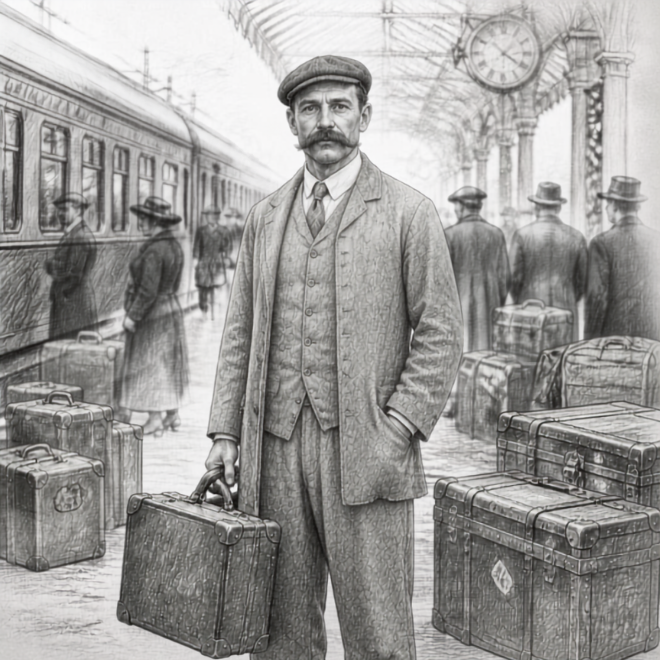
When researching the genealogy of an ancestor, it’s genuinely thrilling to uncover the details of their emigration — a date, the name of a ship, their name on a passenger manifest. Seeing it in black and white lets you begin to imagine the mix of hardship, complexity, and excitement that must have shaped their journey.
But what came before the journey itself? How did our ancestors say goodbye to the friends, neighbours, and communities they were leaving behind, often for good? As you’d expect, the answer looked very different depending on culture and circumstance. Here’s a look at three, at the midpoint of the 19th century.
The Germans
By the mid-19th century, no German family could simply board a ship — they first had to satisfy their home state. Emigrants generally needed to complete their military service, settle any outstanding debts or taxes, and prove legal irreproachability, with no unresolved criminal record. In many states, a man also needed his wife’s consent. The process was public: intending emigrants had to formally announce their departure, giving creditors a final chance to come forward. A local pastor often played a quiet role too, noting the departure directly in the parish register, alongside the same book’s records of births and marriages.
Against all this bureaucracy, the human side of departure remained just as strong. When a family or group of families prepared to leave, it was common for the whole village to send them off together — a farewell that mixed the settling of debts, finalisation of transactions, and celebration with real grief, among neighbours who understood they were unlikely to meet again.
The Scottish
The Highland Clearances continued well into the mid-19th century, and were the trigger for a great many Scottish emigrations. Not everyone who left wanted to — for many, there was simply no viable alternative. Before departing, it was common for Scottish emigrants to make a final visit to the local burial ground, to say goodbye to their ancestors, and to carry a small amount of native soil with them on the journey.
In some cases, entire villages were cleared at once. Accounts from the time describe the resulting procession of villagers leaving their homes as resembling nothing so much as a funeral march — and some landlords went so far as to burn the homes of the departing, removing any possibility of return, forcing villagers to watch their community destroyed as they set off across the countryside toward the port towns. Whole villages sometimes travelled and boarded ship together, passage paid by the landlord, and went on to re-establish their communities on the other side of the Atlantic, in places like Nova Scotia. Bagpipes were often played pierside, and it was common for groups of emigrants to join a local minister in prayer before boarding.
The Irish
Perhaps the most dramatic of all these farewell traditions took place in Ireland. Against a backdrop of stagnant economic hardship and, later, catastrophic famine, those who left were genuinely unlikely ever to return — and their families knew it. In many cases, if either party couldn’t read or write, they might never even exchange a letter again. Out of this grew a tradition known as the American Wake.
The emigrant leaving the village was, in every practical sense, treated as though they had already died to those left behind. The ritual borrowed directly from funeral custom, and applied it to the living. Held on the night before departure, the wake began much like any other — food, whisky, and tobacco fuelling a night that started as celebration and slowly turned to sorrow as the hours wore on. The emigrant sat in their own home while friends and neighbours approached, just as they would a corpse, to offer blessings, memories, and goodbyes. As dawn approached, the older women of the community would perform keening — the traditional, haunting wail of lament ordinarily reserved for the dead. By morning, the family, and often the whole village, walked the emigrant to the edge of the parish, or to the railway station. There, at that boundary, they said their final goodbyes. The emigrant walked away without looking back — considered bad luck — and, in the vast majority of cases, was never seen again.
Coming Home
Later in the 19th century, and into the 20th, the arrival of steamship travel changed the calculus for many. The journey to North America became faster, cheaper, and considerably less arduous — and, for the first time in real numbers, many who left actually returned. Depending on the economic, social, and political conditions back home, “return migration” became a genuine, common path: many who’d earned higher wages in America used them to buy farms, start businesses, or support family still in the old world.
The rate of return varied considerably by nationality. According to economic historian J.D. Gould, an estimated 22% of German emigrants eventually returned home, compared with 12% of English and Welsh emigrants, 11% of Scottish emigrants, and just 7% of Irish emigrants — a figure that says something quiet but powerful about just how permanent the American Wake’s farewell truly was, for most who lived through it.
“Often, the Irish emigrant sat in their own home while friends and neighbours approached, just as they would a corpse, to offer blessings, memories, and goodbyes.”
Sources: FamilySearch Research Wiki, “Württemberg Emigration and Immigration”; FamilySearch Research Wiki, “German Empire Emigration and Immigration”; Legacy Tree Genealogy, “Tips for Researching Your German Ancestors & Their Emigration”; Price Genealogy, “German Immigration”; Library of Congress Research Guide, “German Origins in the United States: Baden-Württemberg”; Beyond History, “Emigration from Germany: Ranging the Fields”; J.D. Gould (return migration statistics); National Library of Medicine (USA); BBC; Scottish Archives Network; Dr. Eileen Metress, “The American Wake of Ireland: Symbolic Death Ritual” (1990).