The Hinkley Family History Project
The Hinkley Project examines a story with a chapter opening on the shores of Kent, England in 1634.
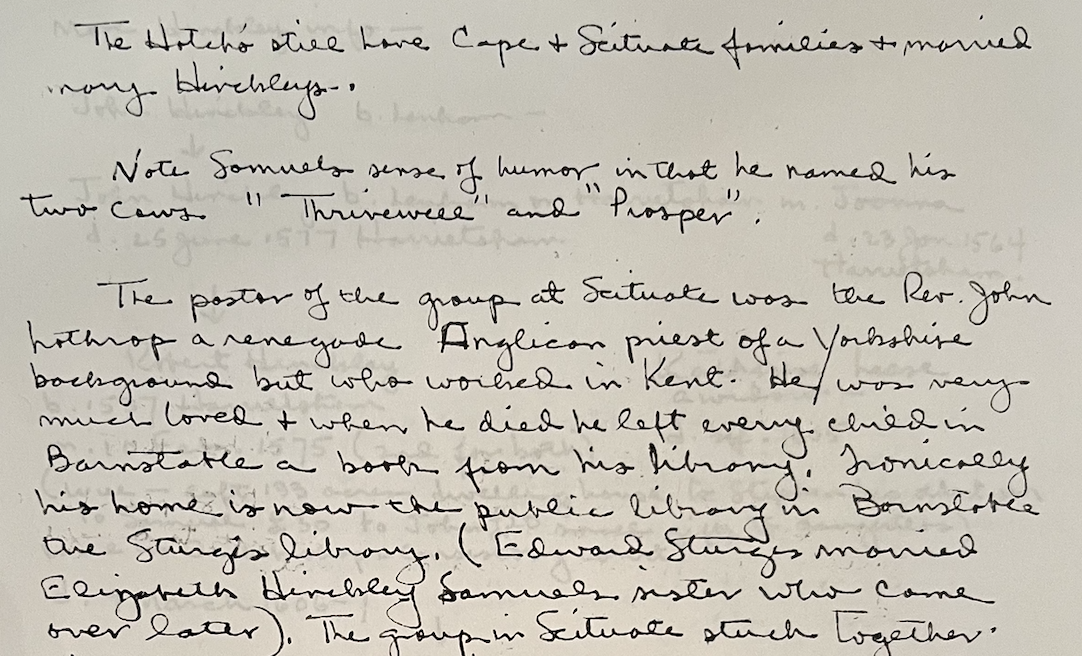
Original family history notes that inspired the research.
The Hinkley family was one of my first family history research projects. Back in 2019, drawn in by my granduncle's initial research dating back to the 1970s. I wound my way back through eight generations to a single departure recorded on a Kentish quayside in 1634. It's one thing to know, in the abstract, that an ancestor left England and was a settler in colonial America. It's another to find the actual record of the day they left — and to keep finding more of it, the deeper you look.
Working back through the generations from our William O. Hinkley (1889-1973), the trail eventually led to Samuel Hinkley (Hinckley), born in 1589 in Tenterden, Kent. On 15 March 1634/5, Samuel enrolled at the port of Sandwich for passage to New England, travelling with his wife Sarah, four children — Thomas, then aged sixteen, along with Susannah, Sarah, and Mary — and a kinswoman, Elizabeth. He was part of a company of 102 emigrants, largely from Tenterden and the surrounding Kent villages, who sailed together at the end of March 1635 aboard the Hercules, a 200-ton ship under Captain John Witherly.
Samuel Hinkley was, by his own community's account, a religious dissenter — and leaving England required him to swear an oath that he conformed to the doctrine and discipline of the Church of England, a declaration many historians believe he made not out of sincere belief but out of necessity: those who refused it outright risked imprisonment. It's a striking detail, and a reminder that the reasons behind the wider Great Migration — a mix of religious pressure under Archbishop Laud and economic strain felt in Kent at the time — could be deeply personal and specific for the individual families living through it.
The company's destination wasn't chosen at random. Elder Nathaniel Tilden, also of Tenterden, had already purchased land in Scituate in 1628, and it's likely the Hercules party intended to join a community already forming around fellow Kent emigrants. Samuel built a house on what the settlers named Kent Street, in tribute to the home they'd left behind. He remained in Scituate until 1640, when he sold his house, farm, and meadows and moved the family to Barnstable, buying land from the Reverend Joseph Hull and building a small, thatched, one-story house near what was known as Rowley's Pond.
In his new community, Samuel was an active figure — by one account, serving as a juror and surveyor of highways "filled the measure of his political aspirations" — but his name recurs steadily in the records: a freeman from 1637, a juror, a highway surveyor, and one of the grantees of land at Suckanesset. One detail stands out: he was twice indicted for "entertaining strangers," a charge commonly used at the time against those who sheltered Quakers. It suggests a man whose own experience of religious pressure in England had left him unwilling to enforce the same intolerance on others in his new home.
Samuel's family life held both fortune and real loss. Sarah died in 1656, and Samuel remarried the following year, to Bridget Bodfish, a widow of Sandwich. Between 1637 and 1641, the family buried four children in quick succession — a son, a daughter, and a set of twins — a stark reminder of how precarious life could be even for a settled, established family. Samuel Hinkley died in 1662; his will, naming his surviving daughters and leaving his second wife two named cows, Prosper and Thrivewell, along with the household goods she'd brought to their marriage, is a small, human window into a life otherwise recorded mostly through land deeds and court appearances.
There's something genuinely striking about finding these kinds of records — a specific date, a specific ship, a specific man who chose to swear an oath he may not have believed, simply to give his family a future somewhere else. Samuel Hinckley wasn't a name on a chart to me after this research; he was a father who buried children, built a house named for the county he'd left, and quietly refused to turn strangers away. Understanding a life like that — and everything that followed from it, generation after generation, until it reached today — is exactly why this work is so important to me.
This portfolio case study shared with the permission of the family.
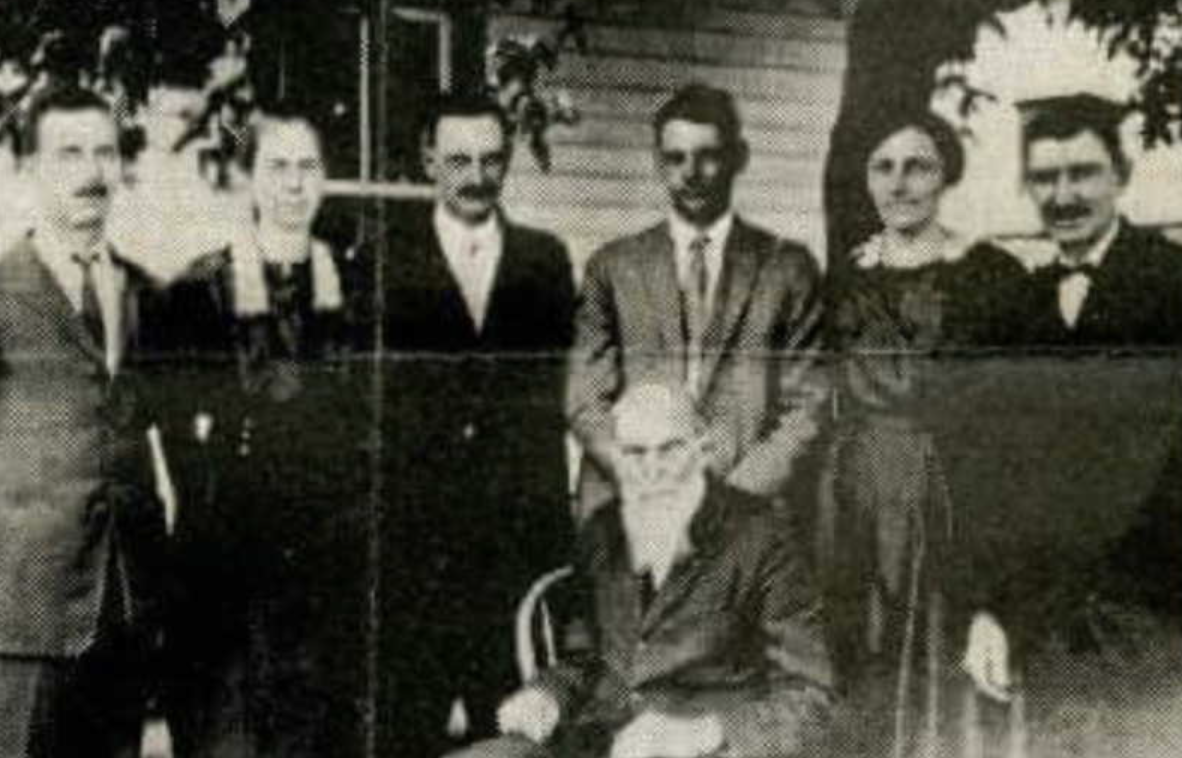
EP Hinkley (1839-1937) and family including WO Hinkley (1889-1973) 3rd from right. Photo abt 1920.
Looking for a family history researcher to trace your own ancestry? Get in touch.
Complete the form with any questions about my services. If you'd like to arrange a no-obligation consultation, share some preliminary details about your project, and I'll get back to you within 48 hours.