
Four Generations in Wales, Wisconsin
Four women, one frame. My ancestors. The oldest is Mary Edwards, born on Christmas Day 1817 in Cardiganshire, Wales. Meet the Williams family …
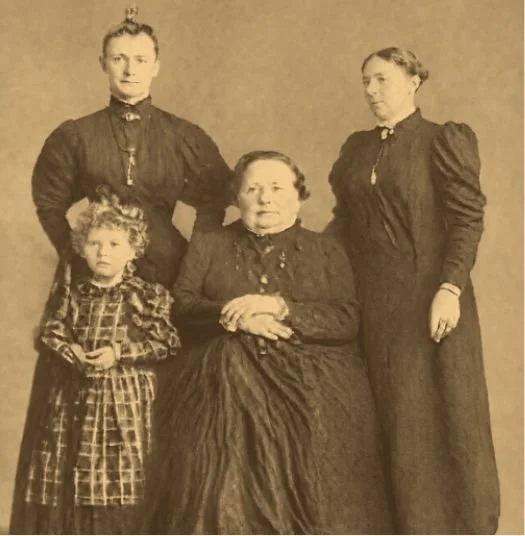
Mary (seated), Mary Jane (right), Maggie (left) and her daughter Mary Ann (youngest). c1895
Mary
Mary Edwards was born in Cardiganshire on 25 December 1817. She married Joseph Jones in 1839. Records suggest she had at least thirteen children. She died in June 1904, aged 86.
Her daughter, Mary Jane, was born in April 1846 in Lledrod Lower, Cardiganshire. A year later the family left Aberystwyth, Wales for New York. They ultimately settled in Wisconsin. Mary and Joseph were joined by Joseph’s brother and his 66 year old father as they set across the Atlantic.
The weight of evidence suggests the family sailed on the Ann Jenkins. This sailing was the barque’s maiden Atlantic voyage. Mary was about 29 when she left Wales, with one year old Mary Jane three young sons in tow. Their journey to New York took 44 days.
Mary Jane and Maggie
Mary Jane Jones grew up in the Welsh settlements of Wisconsin and married Thomas Morgan Edwards who had been born in Montgomeryshire, Wales. Their daughter Margaret Jane was born in December 1869 in Wisconsin. Everyone called her Maggie.
She grew up around Waukesha. By her mid-teens she was working at Owen Rowland’s farm at Bark River, in the house, minding the children. A farm hand there was a young Welshman from Caernarfonshire.
Squint
John Hugh Williams was born on 27 July 1863 in Port Dinorwic (Y Felinheli), Caernarfonshire. Like many men in North Wales, Squint was working in the slate quarries by age 18. Family lore says he got the nickname Squint from a serious eye injury while working in the slate quarries.
He left Wales around 1882, aged 19. He left in search of a doctor in Virginia who might be able to save his sight. In the end, one eye was saved. Squint later settled in Wisconsin amongst other Welsh families.
By the mid-1880s he was working for Owen Rowland. On 1 December 1886 he married Maggie in Waukesha County. They had nine children, in including my great grandmother Mary Ann.
Mary Ann
Mary Ann was born in August 1890 in Waukesha, Wisconsin. She went to grade school and learned to read and write. At home she taught her parents English. The family spoke Welsh at home, and in the evenings they sang in Welsh.
She left school soon after and went to work in a sewing factory. There she met William Hinkley. They married in 1911. She came through the Great Depression and spent one adventuresome year, 1937, working in Florida. Later she separated from her husband, retrained as a nurse and kept working until she was 88.
She made two trips to Wales: in 1959 with her sister, and in 1975 with her niece. She died in Waukesha in 1989, aged 98. As a boy I saw her almost every summer, and she talked about the family and its Welsh roots. I have since been to Wales and likely stood where she stood in 1959 and 1975. Having known her is a tether to these ancestors, and it makes them all the more special to me.
The letter
I’m lucky. Two things have survived that many families lose.
The first is my great-grandmother’s account of this family, transcribed from her own words. The second is a letter from Squint himself. He wrote it in Welsh on 9 December 1907, from Wales, Wisconsin, to his family back in Wales.
By 1907 Squint had been in America for around 25 years. He was farming, and he gave the facts first:
“There are 200 acres of land to work and 20 to 25 cows to milk and about 100 sheep and we raise many pigs every year and therefore you will see that we have to work like the D---1 himself.”
He counted his children by what each one did. The eldest girl worked in a sanatorium, “quite a good place too”. The eldest boy had an office job 28 miles away. A third child was at the high school, eight miles from home. Four more were at the school near home, and the baby was at home.
He doesn’t appear homesick for his life in Wales. He wrote that “one good thing in this country is that if you do not like one place there is plenty of room to move.” He told his brother and sister that “there are very many older than you coming here and doing well.”
He remembered Wales precisely. He recalled his sister Jane “milking at Cae Gwydryn” long ago, and thought she “could milk every cow in the country.” He asked his brother, “Which way are you sailing now – do you ever come to the shores of the large America?”
Squint had thought of visiting Wales that winter. “It costs great deal and there are no cut rates available this year.” To our knowledge, he never returned to Wales before his death. He was struck and killed by an automobile in 1932.
The postscript reads: “It would be better for you to put aside those thick heels. The wife wants you to figure out this problem properly.” Maggie was in the room, or near it.
The ship, the mystery, the search
I haven’t found Squint’s ship.
I know the year, roughly, and the port he left from, and I have six candidate crossings. None is confirmed. There are two hypotheses.
Hypothesis one. I’ve already found the record. It sits among the many John Williamses who landed at New York in the early 1880s, and I can’t yet narrow it to him. Williams was, and is, a very common name in Wales and on the ship’s manifests from this era.
Hypothesis two. He didn’t cross as a passenger. He may have come on a brother’s or cousin’s ship, listed as crew, or even as a stowaway. Both his cousin and borther were mariners, so a berth through family is possible. Mary Ann tells us in her account of his crossing that he came with “…Hugh on one of his ships”
Neither is proven. I continue to research ships records and refine the facts about Hugh’s own movements. The research continues.
What the photograph means
Finding this photo of four generations is a treasure. It reminds me that my ancestors were real people with real lives … not just data to review on a family tree. Squint also evidently treasured family photos, according to his letter, the day after his brother’s family photographs arrived from Wales, they were framed.
Own Your Story.
“There are 200 acres of land to work and 20 to 25 cows to milk and about 100 sheep and we raise many pigs every year and therefore you will see that we have to work like the D—-1 himself.”
Sources: Full source list available on request.